
Knife Hit Master: Arcade Game
Playoff Games Co.Arcade
4.76.00 Reviews
- Version
- 0.5.1
- Installs
- 10.00K
- Age Rating
- Everyone
Screenshots
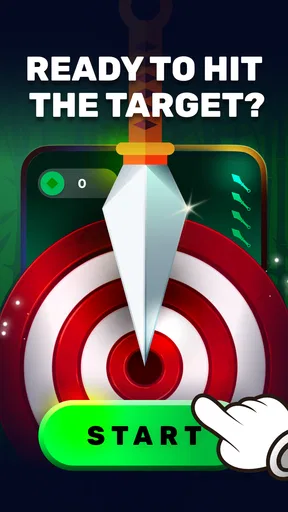
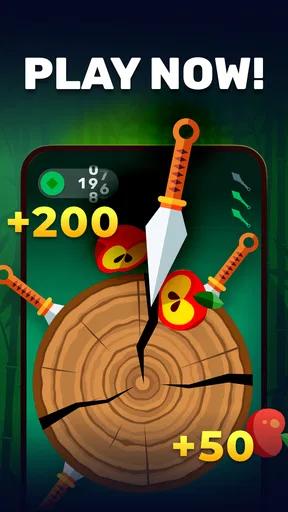


Our Review of Knife Hit Master: Arcade Game
 Analysis by Appyee
I like arcade games that explain themselves before I have time to get comfortable. Knife Hit Master takes that approach immediately: I tap to send knives toward targets, try to place each throw cleanly, and move through compact arcade stages. There is no long setup to learn and no complicated menu structure standing between me and the next attempt. That directness is the main reason I can imagine opening it during a spare minute rather than planning a dedicated gaming session.
Created by Playoff Games Co., this is a free arcade game for Everyone. Its current version is 0.5.1, and it needs Android 9 or later. The game has built a 4.7 average from around 263 ratings and has passed 10K+ installs, which suggests that its simple format has already found an audience without pretending to be a large, feature-heavy production.
Why the first few taps work so well
The central action is easy to understand, but it is not automatically easy to perform well. A tap commits a knife to the target, so the satisfying part comes from reading the available space and choosing a moment rather than simply tapping as quickly as possible. That small distinction gives the game more focus than a basic reflex toy. I am not managing a character, learning a map, or sorting through equipment; I am concentrating on one decision at a time.
The best early experience comes from treating every throw as a timing problem. I watch the target, identify an open section, and tap with enough patience to avoid turning a promising run into an unnecessary mistake. This makes the game approachable for someone who rarely plays arcade titles, while still giving experienced players a reason to improve their control. The premise remains readable even when my attention is divided, which is important for a game designed around quick access.
That clarity also makes it suitable for a very ordinary situation: waiting for a takeaway order, sitting on public transport, or taking a short break between tasks. I can start without remembering a storyline or reconstructing a complicated objective. The game asks for immediate attention, gives me a focused action, and lets the result speak for itself.
The strongest part of the design is its low mental overhead. I do not have to spend the first minute deciding what mode to enter or which upgrade path matters. The useful skill is visible on the screen: place the knives carefully and keep progressing. For a casual player, that is a genuine advantage over arcade alternatives that bury their quick fun beneath several layers of menus, currencies, challenges, or tutorials.
A rhythm built for short sessions
The fast-level structure shapes how I use the game. I can play for a handful of attempts and stop without feeling that I have abandoned a long campaign. That matters more to me than a large amount of content when I am looking for something during a short pause. The game’s appeal is not based on asking for a long commitment; it creates a small loop of aiming, tapping, reacting, and trying again.
I find it helpful to separate two kinds of play. In the first, I use it as a quick distraction and accept that some attempts will be careless. In the second, I deliberately slow down and try to understand why a throw failed. The same basic action supports both moods. It can be light entertainment when I have only a moment, but it can also become a compact accuracy exercise when I want a little more concentration.
The trade-off is that the experience depends heavily on whether I enjoy repeating a narrow action. Players who want varied objectives, exploration, narrative progression, or a changing cast of mechanics may find the format too restrained. This is an arcade game in the clearest sense: its pleasure comes from execution and repetition, not from constantly introducing a new type of task.
For that reason, I would not recommend it as a replacement for a larger action game. A more substantial alternative is better when I want character development, strategic planning, or a session with a clear beginning and end. Knife Hit Master makes more sense beside those games, filling the role of a quick, focused activity rather than trying to compete with them on depth.
How to play when interruptions are likely
One of the practical questions I had was whether this kind of game fits real life, where a notification, conversation, or change of location can interrupt a session. Its short arcade format helps because I do not need to reserve a long block of time. I prefer to begin an attempt only when I can give the screen a little attention, then stop between attempts instead of forcing myself to continue while distracted.
That habit makes a difference. The game is simple, but the timing still benefits from concentration, so playing while walking, crossing a street, or handling another task would be a poor choice. In a safe stationary setting, however, it is easy to return to the same basic goal without a large mental reset. I do not need to remember a complicated sequence of objectives before making the next throw.
My practical tip is to use it as a deliberate “one more attempt” game rather than an endless background activity. Set a natural stopping point after a successful stage or a clean run. That keeps the short-session advantage intact and prevents the repeated action from becoming tiring. It also turns each visit into a small challenge instead of an undefined scroll through attempts.
Another useful approach is to play with a consistent pace. Rapid tapping may feel efficient, but it can make me react to the previous throw instead of reading the next opening. Waiting briefly to see the target’s available space gives the game more of a skill-based feel. This is not a hidden system or a complicated technique; it is simply the difference between treating each tap as a guess and treating it as a decision.
Because the game is free, it is easy to try without making a financial commitment. That is especially useful for people who are unsure whether a minimalist arcade loop will hold their attention. The age rating of Everyone also makes the presentation broadly accessible, although adults looking for sophisticated challenge should judge it by its precision and replay loop rather than expecting advanced systems.
Where replay value comes from
Replay value here comes from improving the quality of my attempts, not from discovering a completely different game on every visit. A successful throw feels good because it reflects better timing and awareness. A failed throw can be useful when I can identify the mistake: tapping too early, rushing into a narrow opening, or losing focus after several successful placements.
This creates a modest but honest form of progression. I am not necessarily returning to uncover a large world; I am returning to see whether I can make the next run cleaner. That is enough for short bursts, particularly when I enjoy games that reward small improvements. It is less convincing for players who measure replay value by new characters, varied environments, extensive unlocks, or a broad collection of modes.
The repetition is also where the game’s main limitation becomes clear. A simple mechanic can feel elegant at first and predictable later. If the target patterns or stage demands do not keep my attention, the loop may lose its pull faster than a more varied arcade title. I would therefore view the game as something to keep available for spare moments, not necessarily as the only game on my phone.
Compared with endless runners, it offers less movement and fewer simultaneous decisions, but that restraint makes it easier to pick up when I want a calm, concentrated tap rather than constant visual motion. Compared with puzzle games, it asks for less planning and more timing. Compared with idle games, it gives me a more active role and asks me to be present. Those differences make its place fairly clear: it suits players who want immediate manual control without a long ruleset.
A good personal test is to notice what kind of failure bothers you. If I enjoy correcting a mistimed action and trying again, the game has a reasonable chance of staying enjoyable. If I mainly want to collect, build, explore, or unlock, I am likely to prefer another category. The game does not need to be more complicated to be worthwhile, but its simplicity means my own tolerance for repetition matters a great deal.
Who will get the most from it
I would point this game toward someone who wants a free arcade experience that can be understood instantly and played in short visits. It is a good fit for a player who likes tapping with purpose, watching a small opportunity appear, and trying to improve after a mistake. It also works for newcomers who may feel put off by games that begin with several tutorials or complex controls.
It is less suitable for anyone searching for a long-form game with a strong narrative, deep customization, social competition, or a wide range of activities. I would also skip it if repeated precision tasks quickly become monotonous. The straightforward format is a strength when I want a clean break from busy games, but it becomes a weakness when I need constant novelty.
For families, the Everyone rating makes the game an approachable choice in terms of its stated age classification. Even so, I would still treat it as a focused arcade pastime rather than something designed to occupy a child indefinitely. The short-session nature is healthier for the experience: play a few attempts, enjoy the challenge, then move on to another activity.
The developer’s choice to keep the core interaction so direct also gives the game a clear identity. Playoff Games Co. is not asking me to learn a broad system before I can enjoy the main idea. That makes the title easy to recommend selectively. I would tell a friend, “Try this if you want a quick timing game,” rather than presenting it as an all-purpose mobile gaming solution.
My casual verdict
After spending time with it, I see Knife Hit Master as a focused little arcade game whose value depends on how much I enjoy repetition with small improvements. Its immediate action is its biggest asset: I can understand the objective quickly, begin playing without preparation, and stop without feeling tied to a lengthy session. That combination is useful in the gaps of an ordinary day.
The 4.7 average and 10K+ installs show that the straightforward concept has attracted positive attention, but the more important question is whether the loop matches my habits. For me, it works best when I want a brief concentration break and do not want to manage a complicated game. I enjoy the moment when a careful throw clears space and keeps a run alive, especially when I know a rushed tap would have ruined it.
I would not choose it over a deeper arcade game when I want variety, nor over a puzzle or action title when I want a more developed sense of progression. Its replay value is real but narrow, built around timing, patience, and the urge to make the next attempt cleaner. That is enough for a free game intended for quick play, provided I approach it with the right expectations.
My recommendation is simple: install it if you want an immediately understandable arcade challenge for short, interruption-friendly sessions. Try it during a quiet break, play with a measured pace, and see whether improving individual throws feels rewarding. If that small loop gives you satisfaction, this is an easy game to keep around. If you need constant novelty or a larger adventure, you will probably be happier with a more expansive alternative.
Verdict
Strengths of Knife Hit Master: Arcade Game
- Simple one-touch controls are easy for beginners to understand.
- Short rounds make it convenient for quick gaming sessions.
- Increasing difficulty keeps later stages challenging and engaging.
- Responsive timing rewards precision and improves replay value.
- Bright arcade visuals make the gameplay easy to follow.
Limitations of Knife Hit Master: Arcade Game
- Frequent retries may feel repetitive after extended play.
- Some stages can depend heavily on precise timing.
- Ads may interrupt the experience between rounds.
- Progression may feel limited for players seeking deeper mechanics.
- The game can become frustrating when mistakes reset a round.
Similar Picks in This Category
View All
Subway Surfers
SYBO Games4.6

Stickman Party 234 MiniGames
PlayMax Game Studio4.6

Subway Princess Runner
Ivy4.4

Temple Run
Imangi Studios4.2

Zombie Tsunami
Mobigame SAS4.6

Stack Ball - Crash Platforms
CASUAL AZUR GAMES4.5
Frequently Asked Questions
What is Knife Hit Master: Arcade Game?
Knife Hit Master: Arcade Game is a casual arcade title focused on throwing knives at rotating targets. The main objective is to tap at the right moment, avoid hitting knives already stuck in the target, and complete each stage by landing the required number of throws. Its simple controls make it easy to start, while faster rotations, unusual patterns, and tougher boss-style targets gradually increase the challenge.
How do you play Knife Hit Master: Arcade Game?
Gameplay is based on timing and precision. A target rotates on the screen while your knives are positioned at the bottom. Tap the display to launch a knife, making sure it lands in an empty section of the target. You must carefully observe the rotation because striking another knife usually ends the attempt. Completing the objective allows you to move forward and face more demanding levels.
Is Knife Hit Master: Arcade Game free to download and play?
The game is generally presented as a free-to-download arcade experience, allowing players to try its core levels without an initial purchase. However, free mobile games may include advertising, optional rewards, or in-app purchases depending on the version and platform. Before installing, check the Google Play Store or App Store listing for current pricing, advertisements, and purchase information available in your region.
Can Knife Hit Master: Arcade Game be played offline?
The basic knife-throwing gameplay may work without a continuous internet connection, which is convenient for short sessions while traveling or when mobile data is unavailable. Nevertheless, some features can require connectivity, including advertisements, cloud-related services, updates, leaderboards, or purchases. It is best to launch the game online at least once and verify which functions remain available in offline mode.
Is Knife Hit Master: Arcade Game suitable for children and casual players?
The game is easy to understand because it uses straightforward tapping mechanics and does not require complicated controls. It can suit casual players who enjoy short, reaction-based challenges, although later stages may become frustrating because they demand accurate timing. Parents should still review the store rating, advertising content, privacy details, and any optional purchases before allowing younger children to play.
Play our best games!


